A dehumidifier addresses moisture when ordinary cooling does not provide enough removal, particularly in mild humid weather. It does not repair leaks or replace ventilation. First confirm humidity, moisture sources and AC operation, then compare portable and ducted options using actual coverage, drainage, controls and maintenance needs.
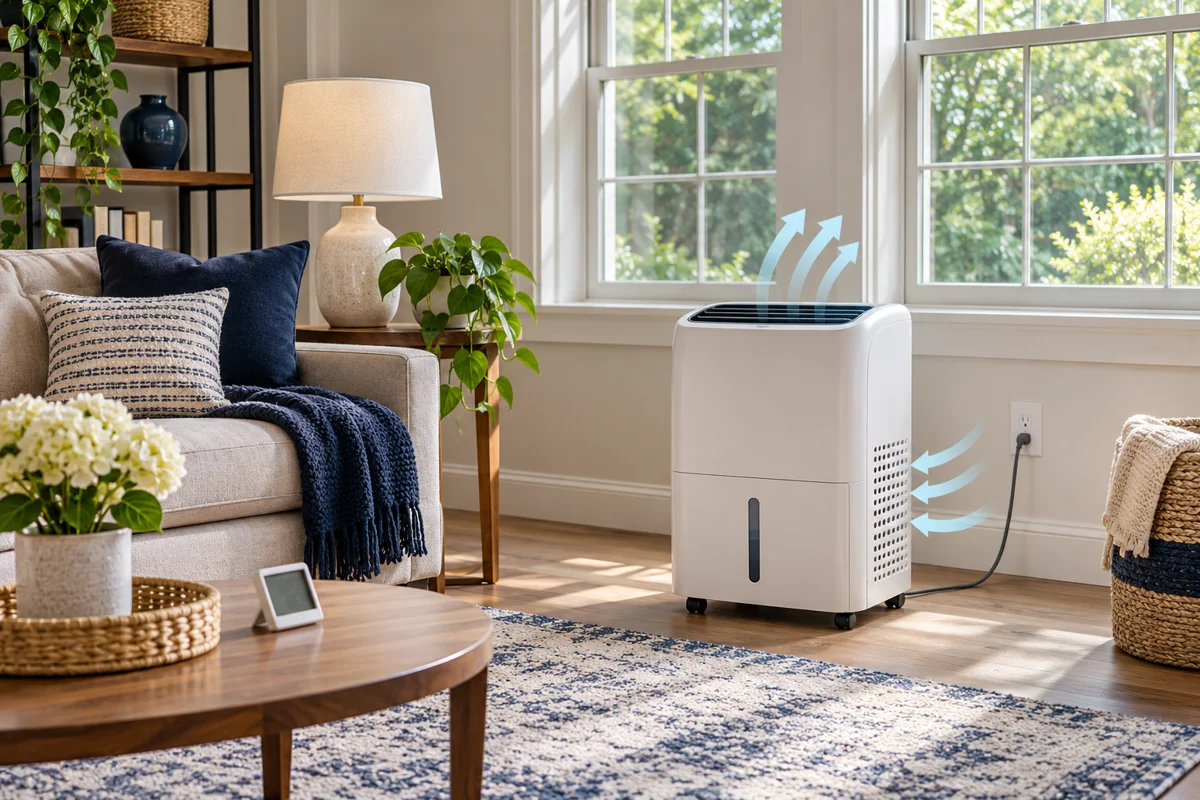
What an AC and a dehumidifier do differently
An air conditioner primarily responds to a temperature demand. Moisture can condense on its cold coil during cooling, but the thermostat may end the cycle before the building's moisture needs are met. A dehumidifier responds more directly to a moisture-control demand and can operate when the house does not need much additional cooling.
That distinction matters during mild, humid weather and in damp lower-level spaces. It does not mean every humid home needs another appliance. Poor drainage, a building leak, unsuitable airflow, or an incorrectly configured AC can create a problem that should be corrected first. Dedicated dehumidification should address the remaining load rather than conceal an ongoing defect.
Start by defining the affected area. One damp basement, an entire house, and a single bathroom after showers are different problems. The right equipment and installation depend on where the moisture originates, how it moves, and what conditions you want to maintain.
Five situations that point to different solutions
The word humid can describe a measurement, a feeling, or visible damage. Separate those before comparing products. A consistent reading from a well-placed instrument provides a better starting point than a coverage claim on a retail box.
These distinctions prevent a common purchasing mistake: solving the most visible symptom with a large appliance while leaving the source and delivery questions unanswered.
- A house that is cool but persistently damp during mild weather may benefit from dedicated moisture control after its sources and AC setup are reviewed.
- A basement with seepage needs water-source correction; a dehumidifier alone does not repair the foundation or drainage problem.
- A home with short cooling cycles may need equipment sizing or control assessment before another system is added.
- A bathroom that stays wet after showers may need an exhaust and use-pattern review.
- A room with an isolated moisture source may be served differently from a whole-house distribution problem.
Measure the problem before choosing capacity
Record temperature and relative humidity in the affected rooms over several ordinary days. Place the instrument away from direct sun, exterior glass, supply outlets, and immediate shower or cooking plumes. Include the basement and thermostat area if they behave differently. Relative humidity must be interpreted alongside temperature.
Note occupancy, showers, laundry, open windows, rainfall, and AC operation. If the home is damp only when cooling does not run, that suggests a different operating need from humidity that stays high during long cooling cycles. Household sensors have limitations, so unusual readings should be checked before they drive an expensive installation.
Ask the professional how capacity will be selected for the actual conditions. Water-removal ratings use test conditions and may not describe performance in a cool basement. Older and newer product ratings also should not be compared casually without checking the test basis. The relevant question is useful removal at your expected operating conditions.
Portable versus ducted dehumidification
A portable unit can serve a defined space and may be a practical way to address a localized need. It requires clear airflow, an appropriate electrical connection, and a reliable water-removal arrangement. A bucket that repeatedly fills and stops the unit changes the amount of moisture control actually delivered.
A ducted whole-house unit can distribute treatment more broadly, but it requires a designed connection to the building's air paths. Ask where it draws air, where it supplies air, whether the central blower must operate, and how the controls interact. Simply attaching equipment to convenient ducts does not establish balanced room coverage.
Compare access for filter changes, service clearance, noise, drainage, and replacement parts. A permanently installed system also has installation and control costs beyond the equipment price. The better choice depends on the area served and maintenance habits, not on an assumption that whole-house equipment is always more effective in every room.
A step-by-step decision process
Keep the order focused on evidence. Buying equipment first can make the later source investigation harder to prioritize, particularly when the new unit makes the room feel temporarily better.
If there is water near electrical equipment, a flooded area, or substantial material damage, address those conditions appropriately before ordinary operation. Do not use a dehumidifier to justify entering an unsafe space or restarting water-exposed equipment.
- Identify the rooms affected and establish a temperature-and-humidity log under ordinary use.
- Investigate visible leaks, seepage, drainage problems, and other unwanted wetting before sizing equipment.
- Review the AC's operation, airflow, fan mode, controls, and installation condition with a qualified professional.
- Determine whether the remaining moisture load is local, widespread, seasonal, or present mainly during low-cooling weather.
- Compare suitable portable and ducted options using actual conditions, drainage, distribution, noise, and maintenance access.
- Agree on controls, completion checks, and follow-up observations before installation begins.
Drainage deserves as much attention as the appliance
Removed moisture must leave through a dependable route. A portable bucket requires emptying and cleaning according to instructions. A hose, floor drain, or pump must be suitable for the installation and local conditions. Poor hose routing, an unsuitable termination, or pump failure can turn moisture-control equipment into another water source.
Ask how the route will be checked and maintained. A ducted system should identify the drain connection and any protective arrangement included in the design. Do not assume an existing nearby pipe is an approved destination. Where another trade or approval is needed, include it in the scope before work starts.
Keep the drainage path accessible. A unit installed behind storage may be difficult to maintain even if it fits physically. Ask what signs indicate a problem and what to do if the equipment stops on a full-water or drain alert. Never bypass a protective shutdown just to keep the unit operating.
How it affects heat and operating cost
A dehumidifier uses energy to collect water and typically adds heat to the space it serves. That can interact with the AC during warmer weather. The net result depends on equipment, controls, moisture load, temperature, and operating hours. It is not useful to promise a fixed bill reduction simply because the house feels less clammy.
Compare efficiency ratings on the same test basis, then discuss realistic operation in your home. Include any central-blower operation required by a ducted arrangement. A high-rated appliance can still disappoint if its air paths or control location prevent it from treating the problem rooms.
Ask for assumptions rather than a guaranteed payback. Sometimes the main customer benefit is better comfort or reduced persistent dampness, not a lower utility bill. Those can be legitimate goals, but they should be described honestly and evaluated separately from energy savings.
Why ventilation and dehumidification are not interchangeable
Ventilation brings outdoor air into the building through a designed or natural path. A typical recirculating dehumidifier removes moisture from indoor air but does not automatically provide outdoor air. Some equipment has an outdoor-air feature, which needs its own design and control explanation.
Outdoor air can either help or increase a moisture problem depending on conditions. Opening windows during humid weather may add moisture even when the air feels cool. Conversely, shutting every intentional ventilation path to lower humidity can create other indoor-air concerns. The building's full arrangement matters.
Ask which function each proposed device serves. An ERV, exhaust fan, portable dehumidifier, and central AC address different combinations of air exchange, moisture, and temperature. A clear proposal explains their interaction rather than using fresh air, filtration, and drying as if they were the same service.
Questions about settings and maintenance
There is no single humidity setting that suits every building surface, season, and occupant. Discuss a practical target with the professional and watch for condensation or persistent dampness in areas away from the sensor. EPA moisture guidance provides context, but an instrument in one hallway cannot describe every wall or basement corner.
Follow the manufacturer's cleaning, filter, and service instructions. Record the selected setting and inspect water removal as directed. If the unit operates continuously without improving conditions, investigate the load, distribution, sensor, and equipment rather than simply choosing the lowest possible setting.
Keep a maintenance record that includes the product, installation date, filter identifier, drainage arrangement, and service contacts. A good installation remains usable after the first season. Easy access and clear instructions often matter more to long-term performance than a minor difference in a headline specification.
Check whether the sensor represents the problem area
A dehumidifier may stop because the air near its sensor reaches the setting while a distant room remains damp. Ask where control conditions are measured and how air from the intended rooms reaches the equipment. A larger appliance may not solve a distribution problem if it keeps treating the same nearby air.
During follow-up, compare representative rooms with normal doors and everyday occupancy. Record whether the unit cycles and whether drainage remains normal. If one area does not improve, revisit the air paths and moisture source instead of automatically lowering the setting for the entire house.
What a useful proposal should include
Request the exact equipment model, the area it is intended to serve, the capacity basis, and the duct or room-air arrangement. Include electrical work, drainage, controls, service access, startup checks, and any exclusions. Ask what improvement should be observed and under which conditions it will be evaluated.
Clucas Mechanical Heating and Air serves Burbank, Oak Lawn, and nearby south and southwest suburbs. Share the ZIP, humidity log, affected rooms, and any known water concerns. Coverage, availability, and the scope of an assessment are confirmed for the actual request.
The decision should follow the remaining moisture need after source and system problems are addressed. A properly selected dehumidifier can be useful; an unnecessary or poorly connected one adds cost and maintenance. A written plan makes it easier to tell which situation applies before committing to equipment.
Sources & further reading
Research checked November 21, 2026. These sources support the technical principles; the planning worksheets apply those principles to customer decisions. Older technical publications are background, not a statement of current local code. Equipment instructions, applicable requirements, and a qualified property-specific assessment determine the actual work.