Choose the highest useful filtration level your actual blower, filter cabinet and duct system can support. MERV 13 captures smaller particles better than MERV 8 under standardized testing, but the rating alone does not establish airflow compatibility. Correct fit, filter area and measured pressure drop matter too.
Start with what MERV measures
MERV describes a filter's particle-capture performance under a standardized test method. A higher rating generally means improved capture in specified particle-size ranges. It does not describe every feature of a filter, and it does not prove that the filter will work properly in any furnace or air handler. Dimensions, construction, fit, surface area, and resistance to airflow still matter.
EPA advises using MERV 13 or the highest efficiency the system can accommodate when upgrading filtration. The compatibility condition is essential. A filter that creates unsuitable airflow conditions may undermine heating or cooling even though its particle rating is attractive. Ask about the actual filter model and installed system rather than choosing from the rating alone.
For a homeowner, the question is therefore two-part: which particles are you trying to reduce, and what filter arrangement can the existing system support? A good answer connects the filtration goal to equipment requirements and measured conditions.
MERV 8, 11, and 13 in practical terms
MERV 8 is commonly used for general residential particle filtration. MERV 11 provides improved capture in smaller particle categories compared with MERV 8. MERV 13 adds stronger capture of still smaller particles under the test method. The differences are meaningful, but installed performance also depends on how much air passes through the filter and whether air bypasses its edges.
Avoid treating the middle number as an automatic compromise. A well-designed filter cabinet may support a useful higher-efficiency product, while a restrictive existing arrangement may need improvement first.
- MERV 8 may fit an existing maintenance arrangement, but it is not the same particle-control choice as MERV 13.
- MERV 11 can be an intermediate option when a specific product and system combination is suitable.
- MERV 13 can support improved fine-particle capture when airflow compatibility and cabinet fit are established.
- None of these ratings means that an ordinary particle filter removes every gas, odor, or indoor pollutant.
- No rating eliminates the need for maintenance, appropriate ventilation, and control of pollutant sources.
Why the same rating can behave differently
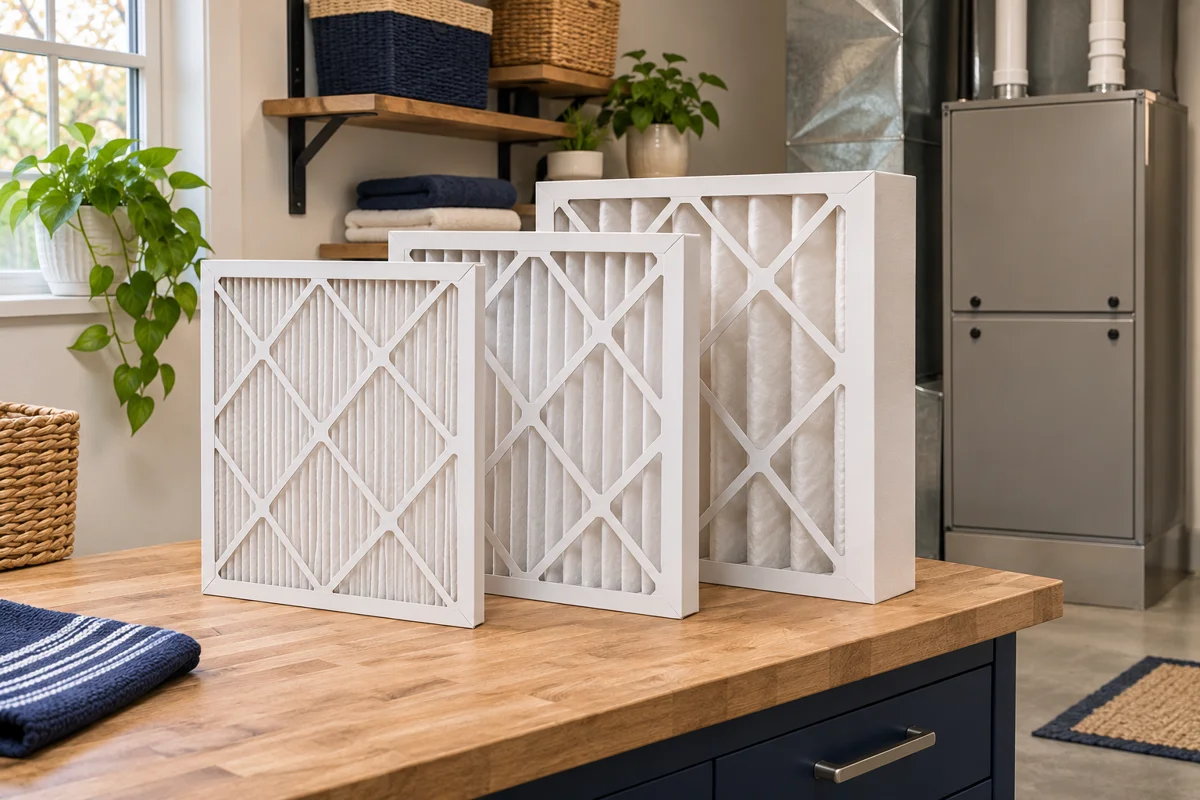
Two filters with the same nominal size and MERV rating can have different pressure characteristics. Media design, pleat spacing, effective surface area, and thickness influence the resistance at a given airflow. A deeper filter cabinet can provide more media area, but depth alone is not proof that every product creates less resistance.
Look for the manufacturer's pressure-drop information at the relevant airflow. The system's total external static pressure and blower capability also affect compatibility. Those are professional assessment questions, not something the appearance of the pleats can answer. A clean filter must fit within the available pressure allowance, and loading during use needs consideration too.
This is why a generic online warning that all MERV 13 filters damage furnaces is unhelpful, as is a promise that every system should accept one. The installed combination and its operating measurements determine whether the choice is appropriate.
A step-by-step filter upgrade plan
Before buying a large pack, identify the equipment and the documented filter arrangement. Some systems have a filter cabinet at the furnace, others use a return-grille filter, and some have more specialized arrangements. Do not add a second filter location without approval; unintended double filtration can change resistance.
A filter upgrade is easier to evaluate when it is the only change. Avoid simultaneously closing vents, changing blower settings, and installing new media without a documented plan.
- Record the equipment model and the filter location using accessible labels and the owner's instructions.
- Write down the existing filter's full dimensions, product identifier, and MERV rating if shown.
- Identify the main goal, such as reducing airborne particles, while documenting any existing weak airflow or cycling problem.
- Ask whether the proposed product is compatible with the blower, cabinet, and duct system at the needed airflow.
- Have relevant pressure and airflow conditions checked when compatibility is uncertain or the system already has symptoms.
- Record the approved product and inspection plan, then follow the equipment-specific installation and maintenance instructions.
Correct fit can matter as much as the label
Nominal dimensions are often rounded; the actual measurements may be smaller. Use the cabinet instructions and the existing approved product information to identify the correct size. A filter that bends into the slot, leaves a gap, or prevents the cover from seating properly is not a satisfactory match.
Air that bypasses the media is not being filtered as intended. Ask about missing gaskets, a damaged rack, or a poorly fitting cabinet cover if those conditions are visible during permitted homeowner access. Do not improvise with materials inside equipment or tape over openings whose function you do not understand.
Install the airflow arrow as the equipment and filter instructions direct. If the direction or access point is unclear, stop and ask. Never reach into an operating blower compartment. A well-fitted, documented filter arrangement is more useful than a higher rating installed in a way that leaves the system leaking around it.
How to watch for an unsuitable change
After an approved change, pay attention to new weak airflow, unusual whistling, heating shutdowns, cooling problems, or a change in room comfort. These observations do not prove the filter caused the issue, but their timing is relevant. Keep the packaging information so the technician can identify the exact product.
Do not run the system without a filter as a test. Do not compensate by opening electrical panels or increasing blower speed. If the system trips repeatedly, develops ice, or shows another significant warning, stop experimenting and request assessment. A protective device should not be bypassed to preserve airflow.
Ask the servicing professional to compare the actual operating conditions with the equipment requirements. If the new media is unsuitable, discuss a compatible replacement or a cabinet and duct improvement. The answer should preserve both filtration performance and system airflow rather than force a choice based only on a marketing label.
Replacement intervals depend on loading
A higher rating does not produce a universal replacement interval. Dust, pets, renovation activity, occupancy, operating hours, filter area, and outdoor conditions influence loading. Follow the manufacturer's instructions and inspect at a suitable interval for the installation. A calendar reminder is a prompt to check, not proof the filter remains acceptable until that date.
Ask whether the professional can provide a condition-based maintenance recommendation for your system. Where pressure monitoring is appropriate, it can add useful information beyond surface color. A dark-looking filter and a highly restrictive filter are not always the same thing.
Keep dates and product identifiers in a maintenance record. If filters load much faster than before, investigate changed conditions rather than only buying more replacements. Renovation dust, damaged return ducts, or an unusual particle source may need separate attention. Wet media is a water-source problem, not ordinary dust loading.
When a portable air cleaner may help
If the central system cannot support the desired filtration without further work, a properly selected portable air cleaner can be another particle-control tool for an occupied room. It needs suitable clean-air delivery, usable placement, and an operating level people will actually tolerate. It does not correct a defective furnace or cooling system.
Compare the room served, noise, filter availability, replacement cost, and the type of pollutant the device addresses. A particle cleaner should not be sold as complete control of every odor or gas. Avoid equipment that intentionally produces ozone in occupied spaces. Source control and appropriate ventilation remain part of the broader indoor-air plan.
Ask for separate explanations of central filtration and room air cleaning. Installing both may be reasonable, but their functions should be clear. The decision should follow the actual concern rather than bundle unrelated accessories into a filter discussion without evidence of need.
Questions to ask before buying a new filter cabinet
A cabinet upgrade should identify the exact product, how it connects to the duct system, and what operating conditions it is intended to support. Ask about service clearance, access for future filter changes, sealing, replacement-media availability, and whether other duct restrictions remain. A large cabinet cannot by itself fix every airflow problem.
Request documentation of the proposed filtration level and how the completed work will be checked. Confirm whether installation includes any necessary sheet-metal changes and finish work. Keep the dimensions and part number somewhere accessible so future maintenance does not depend on guessing from the old filter.
If the concern is an existing comfort problem, have that concern assessed as part of the scope. A cabinet replacement should not be presented as a guaranteed cure for every cold room, odor, or bill increase. The relevant evidence should connect the work to the problem being solved.
Sources & further reading
Research checked November 21, 2026. These sources support the technical principles; the planning worksheets apply those principles to customer decisions. Older technical publications are background, not a statement of current local code. Equipment instructions, applicable requirements, and a qualified property-specific assessment determine the actual work.