A useful commercial maintenance visit follows an asset-specific scope and documents condition, operating measurements, safety findings and recommended action. Depending on the equipment, that can include filters, belts, coils, drains, controls, combustion, ventilation and economizers. A generic checklist or filter change alone does not establish that the system was tested.
Begin with the asset list and written scope
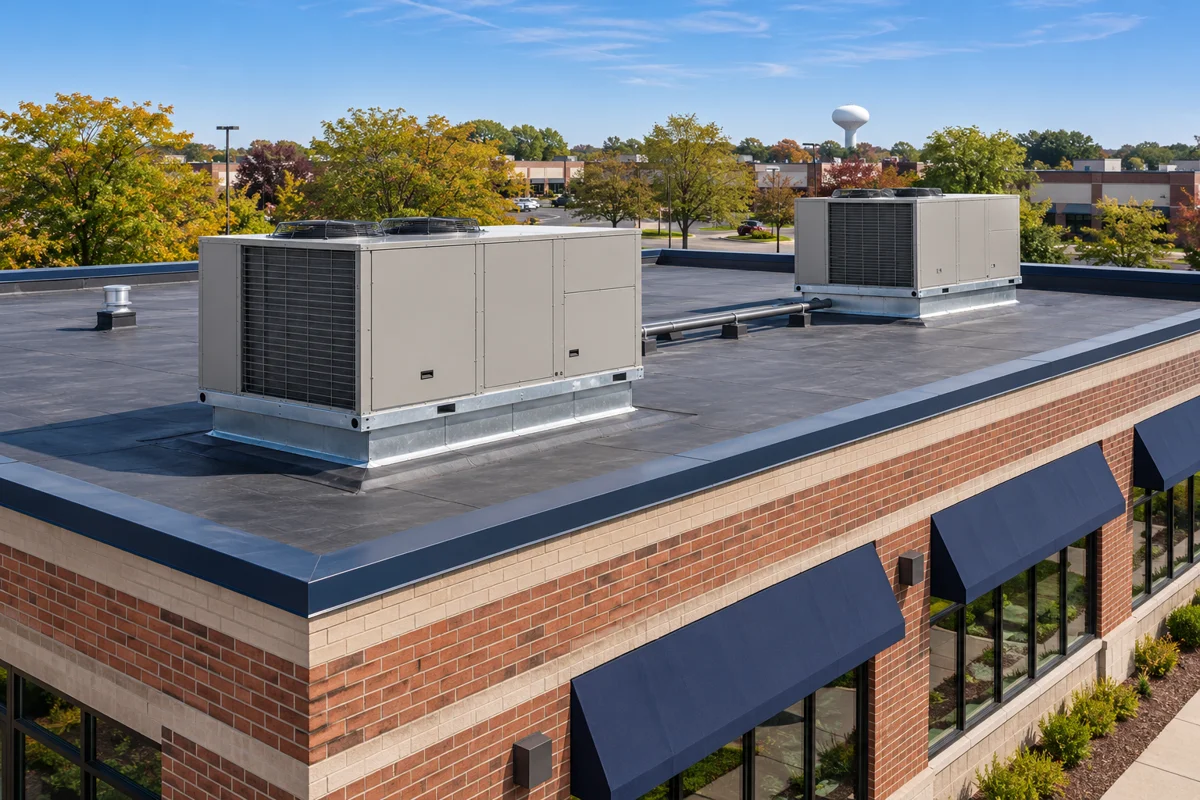
Commercial HVAC maintenance is not one identical visit for every building. A packaged rooftop unit, boiler, split system, exhaust fan, and ventilation unit have different service requirements. The manufacturer's instructions, operating conditions, building use, and known issues should shape the work. A generic checklist is useful only when it maps to the actual assets.
Start with a list of equipment and the areas each asset serves. Include model information, accessible records, operating hours, controls, and relevant service history. Missing asset identification can lead to uncertainty about what was inspected, particularly on roofs with multiple similar units or spaces with separate tenant equipment.
The agreement should describe tasks, visit frequency, reporting, exclusions, and how additional repairs are authorized. A maintenance contract is not automatically an all-parts warranty or a promise that breakdowns cannot occur. Clarify those distinctions before comparing prices.
Eight work categories to discuss
Not every item applies to every unit, and some require specific qualifications or additional scope. The point is to make the contractor's coverage explicit rather than assume a filter change includes all functional testing.
Ask which tasks are included at each visit and which are seasonal, condition-based, or separately quoted. The resulting schedule should remain understandable to a property manager who is not an HVAC technician.
- Filters and air paths: product, fit, condition, loading, and relevant airflow observations.
- Coils and heat-transfer surfaces: condition and cleaning needs appropriate to the equipment.
- Fans, belts, bearings, and drives where fitted: condition and manufacturer-directed service.
- Condensate pans, drains, and pumps: condition and intended water removal.
- Electrical and operating components: qualified inspection and measurements as appropriate.
- Heating and combustion functions where applicable: equipment-specific safety and performance checks.
- Controls, schedules, sensors, and alarms: verification of intended operation.
- Outdoor-air, exhaust, and economizer functions: applicable sequence and condition checks.
Maintenance versus repair versus commissioning
Maintenance preserves and evaluates equipment condition through appropriate recurring tasks. Repair corrects a fault or damaged component. Commissioning verifies that equipment and controls perform the intended sequences within the building system. These activities can overlap, but they should not be treated as interchangeable promises.
For example, changing a rooftop filter does not prove that the economizer opens under suitable conditions or that outdoor airflow is adequate for current occupancy. A technician may identify those concerns during maintenance, but additional testing or design review may be needed. Ask where that boundary lies.
The report should distinguish completed tasks, confirmed faults, recommendations, and limitations. An unchecked box should not leave the owner wondering whether the item passed, was inaccessible, or did not apply. Clear status categories reduce misunderstandings and make the next service visit more useful than a stack of nearly identical forms.
A step-by-step owner preparation checklist
Facility staff can improve the value of the visit by organizing information and access. They should not climb roofs, open electrical compartments, or perform equipment work outside their training and authorization.
This preparation prevents a common mismatch: the manager expects a building-performance investigation while the scheduled visit covers only routine equipment service. If the concern is ventilation or persistent uneven temperatures, state that before the appointment.
- Confirm the current asset list, areas served, normal occupancy, and actual business operating hours.
- Share recent complaints, alarms, water issues, unusual bills, and previous repair recommendations.
- Arrange authorized roof, plant-room, tenant-space, and control-system access using the building's procedures.
- Identify sensitive operations and any periods when testing or equipment shutdown requires coordination.
- Agree on the written maintenance scope and how discovered repairs or urgent conditions will be reported.
- Review the completed report, assign follow-up decisions, and retain measurements with the asset history.
Filters should have a documented product and condition
The report should identify filter size, type, quantity, rating where relevant, and whether the installation fits properly. A statement that filters were changed is incomplete if the replacement product differs from the approved arrangement. Filter resistance and system capability matter alongside particle capture.
Inspection intervals should reflect operating hours, dust, outdoor conditions, occupancy, and manufacturer guidance. A restaurant, office, and construction-adjacent retail space may load filters differently. Where pressure-drop monitoring is appropriate, document the measurement conditions and the applicable criteria. Color alone is not a complete measure of loading.
Ask what happens when a filter is wet, damaged, or loading unusually quickly. Those conditions can indicate another problem requiring assessment. Replacing media should not silently close the issue if the cabinet leaks or drainage is wetting the filter. Keep product changes and recurring abnormal findings visible in the record.
Controls and schedules need real operating context
A schedule that matched the tenant two years ago may no longer match cleaners, early staff, late events, or weekend occupancy. Review occupied and unoccupied periods, holidays, overrides, and seasonal clock changes. Heating and cooling calls, fan operation, and outdoor-air ventilation may have different control sequences.
Ask whether the visit checks sensors and relevant sequences or merely reads the thermostat. A plausible display does not prove accurate sensing or that the connected equipment responds as intended. Document any control changes, the reason for them, and the resulting test.
If building controls are managed by another vendor, coordinate access and responsibility. An equipment contractor should not be assumed to have authority to change every building-wide setting. The owner needs a clear record of who controls schedules, who responds to alarms, and how temporary overrides are returned to ordinary operation.
Ventilation and economizer checks deserve explicit scope
Commercial equipment may heat and cool while its outdoor-air or economizer function is impaired. A stuck damper, unsuitable setting, sensor problem, or altered occupancy can affect ventilation or energy use without producing an obvious temperature failure. These functions need more than a statement that the unit runs.
Ask which outdoor-air and economizer checks are appropriate for the installed equipment. The test conditions matter: weather may limit what can be fully demonstrated during one visit. If seasonal verification is deferred, identify the follow-up rather than marking the entire function complete.
Maintenance does not substitute for a ventilation design review after major changes to occupancy or space use. New partitions, a conference room, or a change from storage to occupied use can alter requirements. The contractor should identify when the question exceeds routine service and requires engineering, balancing, or another qualified scope.
Drainage and building interfaces should be visible
Coil pans, drains, pumps, roof curbs, and nearby water paths can affect the building as well as the unit. A maintenance report should record relevant visible conditions and clarify what was tested. Water reaching ceilings or electrical areas deserves prompt attention rather than a note to watch it indefinitely.
Roofing and structural findings may require another trade. Ask how such issues are communicated and whether photographs can be taken by authorized personnel. An HVAC technician identifying a suspect curb condition does not necessarily mean the roofing repair is included in the maintenance contract.
Keep recommendations assigned to an owner and a next action. Otherwise, the same unresolved water concern can appear on several reports without anyone arranging the necessary work. A useful record says what was found, who needs to assess it, whether equipment use is restricted, and what evidence will close the issue.
What a valuable service report looks like
The report should identify the asset, date, technician or provider, operating conditions, completed tasks, relevant measurements, findings, and limitations. Recommendations should be prioritized with reasons. Urgent safety or equipment-protection concerns should be communicated through the agreed process rather than buried among routine suggestions.
Compare measurements over time where the conditions make the comparison meaningful. A value taken with a different fan mode or outdoor condition may need interpretation. Consistent records help distinguish gradual deterioration, recurring faults, and one-time events without treating every change as a failed component.
Ask for a readable summary and supporting details. The manager needs to understand what decision is required; the next technician needs enough technical context to continue the work. A page of checkmarks without identified equipment or findings serves neither purpose well. Retain reports centrally rather than only in individual staff inboxes.
Agree on how urgent findings are communicated
Before the visit, identify the authorized contact for a condition that requires stopping equipment or prompt action. Specify how the provider reaches that person and how the finding is documented. An email report delivered after the business closes may be insufficient for an issue that affects current operation.
The process should also distinguish urgency from ordinary budgeting. A recommendation for future improvement should not be confused with a restriction on use. Clear wording helps the manager act appropriately, arrange another trade if needed, and avoid either ignoring a serious finding or treating every optional upgrade as an emergency.
How to compare maintenance proposals
Compare asset coverage, tasks, frequency, qualifications, reporting, access arrangements, response terms, exclusions, and repair authorization. A lower visit price may reflect a narrower scope. Conversely, a long checklist does not prove that every task is applicable or performed. Ask how completion is documented for your equipment.
For a commercial request to Clucas Mechanical Heating and Air, provide the property ZIP, business type, asset records, access requirements, and main concerns. Equipment scope, coverage, and availability in Burbank, Oak Lawn, and nearby suburbs are confirmed for the property. Do not assume every specialist system is covered without discussing it.
The best maintenance arrangement is one the owner can use: defined equipment, appropriate tasks, clear findings, and assigned follow-up. Its value comes from documented care and informed decisions, not from a promise that a routine visit eliminates every future failure.
Sources & further reading
Research checked November 21, 2026. These sources support the technical principles; the planning worksheets apply those principles to customer decisions. Older technical publications are background, not a statement of current local code. Equipment instructions, applicable requirements, and a qualified property-specific assessment determine the actual work.