Outdoor equipment needs the space specified for its particular model and installation. This guide helps you notice crowding and remove loose items lying safely on the ground nearby. It does not give a universal clearance distance or cover coil cleaning, guard access, ice removal or pruning against the unit. If safe access or the instructions are unclear, leave the area undisturbed and ask for help.
Is this the right check for your system?
Ground-level outdoor equipment with dry, stable access and no active fault or immediate hazard.
- Read the applicable owner instructions; model requirements take precedence over general yard-care advice.
- Use the normal thermostat off control and wait until operation has stopped according to the manual. Never treat that as electrical isolation.
- Do not reach under a cabinet, through a guard or around wiring, piping or sharp surfaces.
What you need
- The equipment manual or relevant model information.
- A way to collect loose leaves or light items from safe ground nearby.
- Optional private notes or a distance photograph of crowding.
Stop and get help if…
- Ice, snow attached to equipment, damaged wiring or bent guards.
- Debris tangled with pipes, wiring, fins or equipment supports.
- Wet or unstable ground, inaccessible space, severe noise or burning smell.
Follow the steps & keep your notes
Use this working copy for the task described above. Follow your equipment instructions and the stop signs before making a change.
Check an item when you have reviewed or completed it. You can stop and request help at any point; a checkmark does not confirm the system is safe or repaired.
Check the owner documents or official model manual for operating clearances. Note the required sides and overhead considerations only if the instructions are clear. Do not substitute a number from another model. If you cannot establish safe access, make a note for service and stop.
What to expect: You either have applicable guidance or a clear reason to leave the surroundings for assessment.
Use the ordinary thermostat off setting as the manual describes and wait for operation to stop. Do not pull disconnects or open cabinets. If the unit does not stop as expected, leave it alone and request help rather than approaching moving components.
What to expect: Operation has stopped as expected, or you have paused the task.
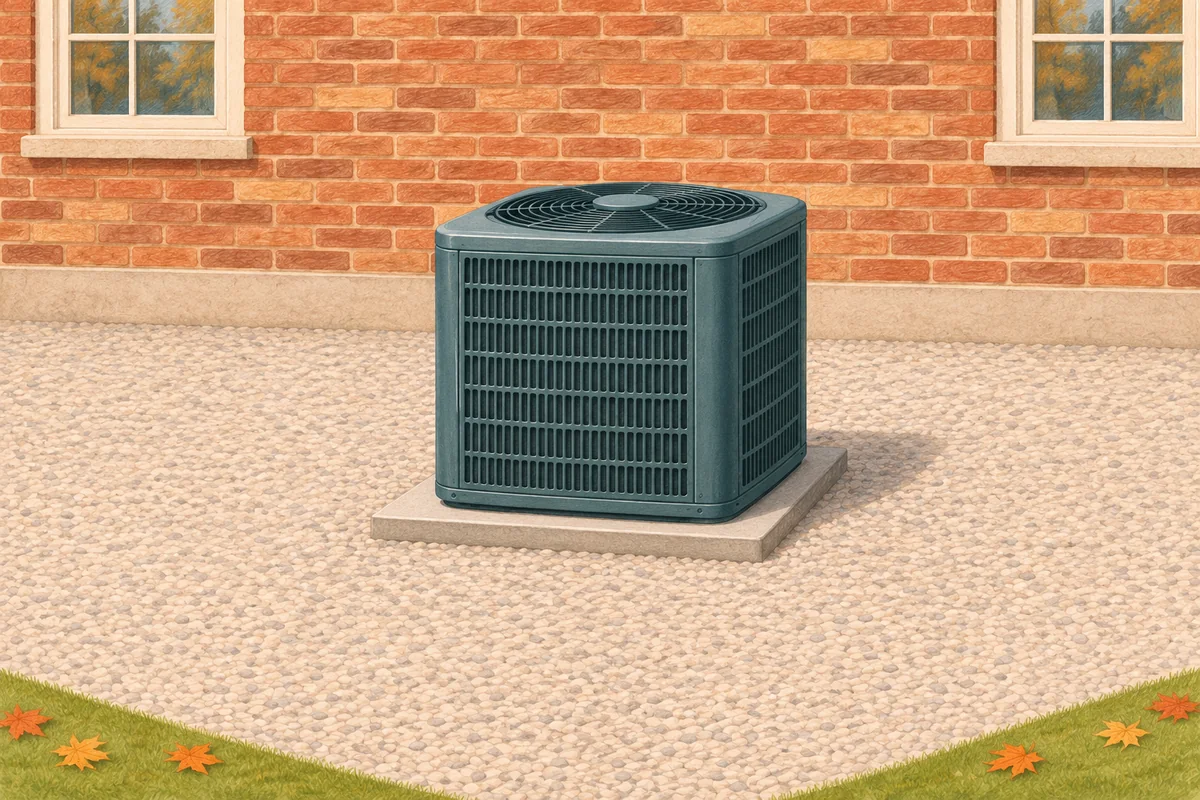
Look for stored items, vegetation or loose ground debris that crowds the equipment or its intended access. Stay on stable ground. Note overhead structures and hard-to-reach sides without climbing or squeezing behind the unit. Do not touch coils, fins, piping or guards.
What to expect: You can describe the location of an obstruction without entering the equipment space.
Pick up loose leaves or lightweight objects lying on the ground safely away from equipment, following the manual's limits. Leave anything touching, trapped beneath or tangled with the unit. Do not scrape snow or ice, trim against piping, use a hose or add a cover.
What to expect: Ordinary loose items are removed without contact with equipment or its connections.
Confirm that collected material is taken away rather than piled elsewhere against the unit. Note any remaining vegetation, structure or inaccessible side for professional discussion. If there was no active equipment fault and all stop signs are absent, return the normal control to its prior setting according to the manual.
What to expect: The safely reachable ground is clear and unresolved access or operating concerns are documented.
________________________________________________________________
Notes stay on this page until you leave. Print or download to keep a copy. Leave out account numbers, payment details, health information and other sensitive information. Nothing is sent to us until you submit a service request.
Keep the observations. Get the right help.
Ask for assessment where vegetation, structures or damaged components interfere with the equipment. Do not keep approaching a faulted unit to make the area look tidy; outdoor access care does not establish that cooling or heating is safe to resume.
Sources & further reading
Equipment instructions and a home-specific assessment take priority over general guidance. This page explains principles; it does not diagnose your equipment remotely.